Bridge Notes
Choosing the Opening Lead Against 3NT: Length or Sequence?
First published on Bridge Winners, where the discussion continues. This version includes some changes made after the Bridge Winners posting: Hand 2 was replaced with a cleaner deal, and one sentence about the ♠Q lead was adjusted.
"Lead the fourth best of your longest suit" is the right default against notrump. This article is about the occasions when a different suit deserves the lead, and how to tell which.
You have to decide before dummy appears, so everything here rests on three things you can see: your own hand, the auction, and what the opponents have bid and not bid.
The default, and why it works
Against 3NT, declarer usually has nine tricks if he is left alone. You win the race by setting up your long suit before he sets up his. So the starting order is:
- Top of a solid sequence in your longest suit (Q J 10 9 6: lead the queen, not the nine or the six).
- Fourth best from a long suit headed by an honour but no sequence.
- Avoid leading away from an ace against notrump if you have any reasonable alternative. A low card from A-x-x-x-x gives up the control that makes the ace valuable.
Two hands show where the order holds and where it bends.
When the default is right
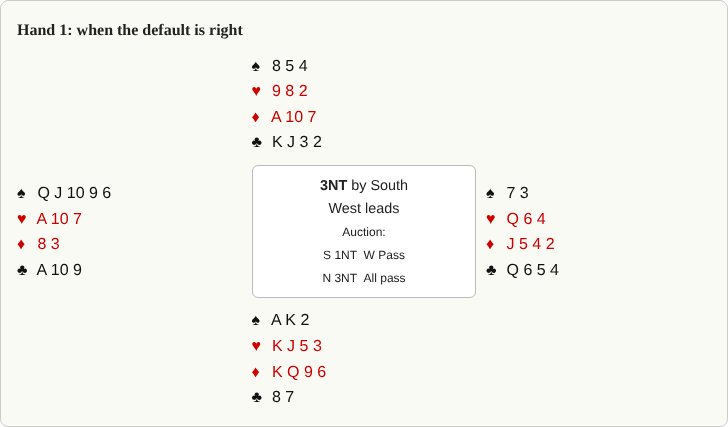
West has a five-card suit with a three-card sequence, and nothing else in the hand is worth leading. Lead the ♠Q.
The card matters. Against the ♠Q lead, 3NT makes only about one time in four. If West leads a small spade instead, it makes about half the time. A good suit deserves its top card, not the "fourth best" you'd lead from a weaker holding.
When the default bends
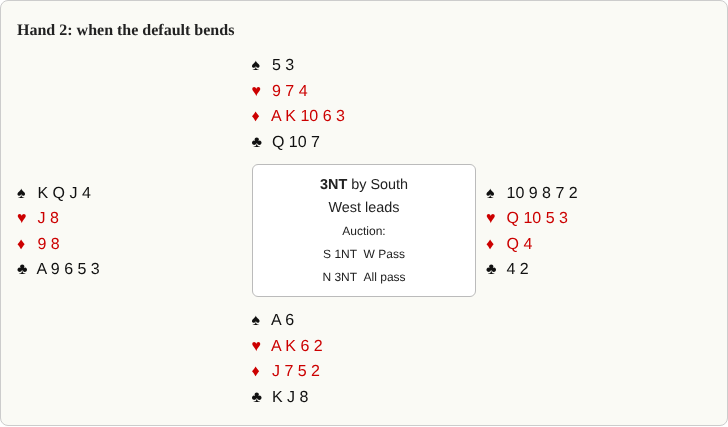
West has two candidates. The longest suit is the clubs: ♣A9653, which means leading a low card away from the ace. The other is ♠KQJ4, a four-card sequence of touching honours.
The default says clubs. I'd lead the ♠K.
Leading low from an ace-high suit gives declarer a free pass at that suit and leaves your ace as your only entry, with no way of knowing whether partner can help. The spade sequence is a source of tricks that doesn't depend on anyone else, and it forces declarer to decide early. On this deal the ♠K lead beats 3NT. The ♣3 lead lets it make.
What to take away
- With a sequence in your long suit, lead the top of it.
- If your long suit is headed by an ace and you also hold a solid sequence in another suit, think twice before leading low from the ace.
- A weak long suit is not a reason to ignore a strong short one.
Before you pick a card, ask three questions. Do I have a sequence? Is my long suit one I'd be leading from an ace? Which suit can produce tricks without help from partner? The default is where you start, not where you have to finish.
(Both hands were checked with a double-dummy solver, including with dummy unseen, as it is at the table.)
What readers added
Summary of the discussion on Bridge Winners (paraphrased, without names). Hand 2 above was replaced after a reader pointed out a problem with the original deal.
- A fuller order of questions. A reader suggested asking, in order: what the auction shows about their shape and strength; what your own hand suggests about partner; how many entries you and partner have, and whether you can set up length tricks and still get in; whether the defense should be passive or active; which suit; and which card.
- Entries. When two suits look about equal, lead the suit in which you have no quick entry. An ace in the other suit usually gets you in later to lead your own suit again. On both hands in the article, this points to a spade.
- Passive or active. After a power auction such as 1NT–3NT, lead aggressively; if partner is likely very weak or the opponents' auction was tentative, lean passive.
- Majors after a direct 3NT. If the opponents play Stayman, a direct 3NT usually means no four-card major, so the major suits are where your side's length is likely to be. Readers disagreed about how much to rely on this, since whether Stayman and transfers are used is a matter of partnership philosophy.
- A problem with the original Hand 2. In the original deal, North held a four-card major and still bid 3NT directly, which many players would not do. The Hand 2 shown here has a North with no four-card major, and the ♠K lead still beats 3NT. The margin over a club lead is modest, and it is one hand, not a rule.
- Scoring. The article aims to defeat the contract. At matchpoints, overtricks matter and the best lead can differ.
- "Longest and strongest." A reader noted that "lead your longest and strongest suit" has a flaw, which is the point of Hand 2: length headed only by an ace is a weak target.
- Agree your leads. A reader's survey of club players found that many don't lead fourth best, don't use the Rule of 11, or aren't sure their partner does. Whatever you play, agree it with your partner.